EN
EN







- Overview
- Specifications
- Description
- Applications
- Key Features
- Key Advantages
- FAQ
- Recommended Products
Overview
Place of Origin: |
Sweden |
Brand Name: |
ABB |
Model Number: |
REA101-AA RLY-REA101-AAAG |
Packaging Details: |
Original new Factory Sealed |
Delivery Time: |
5-7 days |
Payment Terms: |
T/T |
Supply Ability: |
In stock |
Specifications
|
Parameter |
Value |
|
Model |
REA101-AA RLY-REA101-AAAG |
|
Product Type |
Arc Protection Relay |
|
Dimensions |
14.8 x 26 x 26.5 cm |
|
Weight |
4.34 kg |
|
Rated Current Input |
1 A / 5 A |
|
Continuous Load Current |
4 A / 20 A |
|
Momentary Current (1 s) |
100 A / 500 A |
|
Dynamic Current Withstand (half-wave) |
250 A / 1250 A |
|
Input Impedance |
<100 mΩ / <20 mΩ |
|
Rated Frequency |
50 / 60 Hz |
|
Trip Contacts HSO1/HSO2 Voltage |
250 V DC/AC |
|
Trip Contacts Continuous Carry |
1.5 A |
|
Trip Contacts Make & Carry (0.5 s) |
30 A |
|
Trip Contacts Make & Carry (3 s) |
15 A |
|
Trip Contacts DC Breaking Capacity |
5 A / 3 A / 1 A (48/110/220 V DC) |
|
Trip Contact TRIP3 Continuous Carry |
5 A |
|
Signal Contacts IRF Continuous Carry |
5 A |
|
Signal Contacts Make & Carry (0.5 s) |
10 A |
|
Signal Contacts Make & Carry (3 s) |
8 A |
|
Signal Contacts DC Breaking Capacity |
1 A / 0.25 A / 0.15 A (48/110/220 V DC) |
|
Relay Power Consumption (idle/operating) |
~9 W / ~12 W |
|
Max Port Output Power |
~19 W |
|
Max Extension Units per Port |
5 |
|
Max Power Consumption (10 extensions) |
<50 W |
|
Operating Temperature |
-10 °C to +55 °C |
|
Storage/Transport Temperature |
-40 °C to +70 °C |
Description
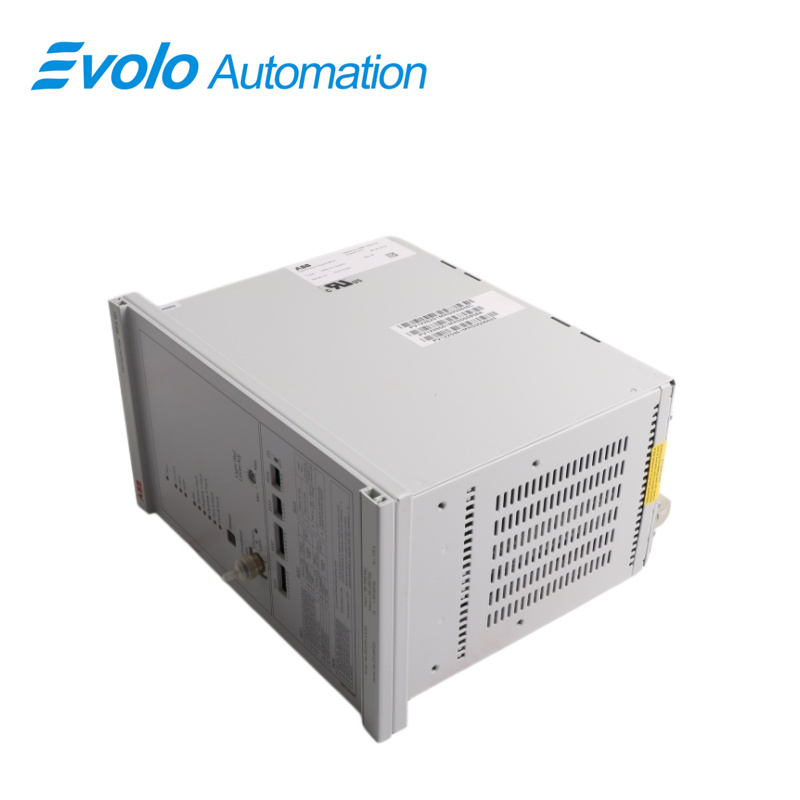
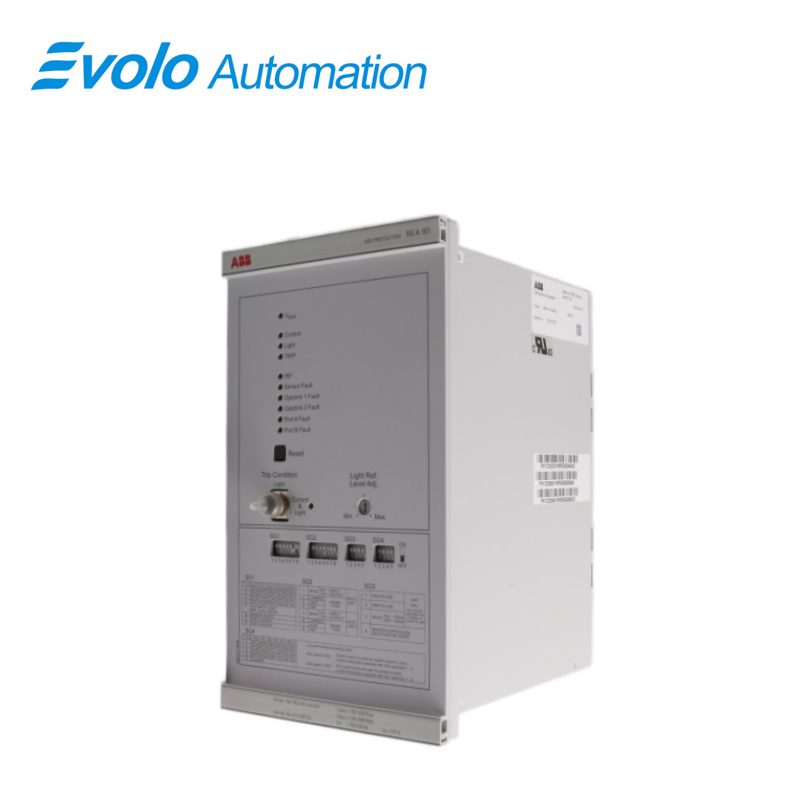
The REA101-AA RLY-REA101-AAAG arc protection system is designed to give fast trip commands to all circuit breakers (CB) that may feed an arc fault in low voltage or medium voltage air insulated metal-clad switchgears. In an arc situation, the fault can quickly be localized by inspecting the cover area of the sensor that detected the arc. Two sensor types are available:
Patented long fiber sensor that detects light along its entire length
Light collecting lens-type sensors, typically distributed one per each compartment.
Applications
Chemical plants: Complex environments necessitate protection against fires or explosions caused by electric arcs.
Data center plants: Protecting high-density power distribution systems to prevent site-wide blackouts due to localized faults.
Steel and metallurgical plants: Monitoring high-current electric arcs in high-power motor control centers (MCCs).
Solar/wind power plants: Implementing ultra-fast short-circuit protection within substation distribution cabinets.
Semiconductor manufacturing plants: Protecting expensive cleanroom power distribution systems.
Key Features
Optical detection using ring or radial fiber optic sensors, or lens sensors.
High-speed IGBT output for direct circuit breaker disconnection.
Two optoelectronic connectors for rapid, long-distance transmission of optical/current/trip signals between main modules.
Relay outputs for circuit breaker failure protection or alarm output.
Two RJ45 ports, each supporting up to 5 expansion modules.
Selective tripping options via other REA 105 expansion modules.
Key Advantages
Rapid tripping with reversible three-phase or two-phase overcurrent and zero-sequence overcurrent criteria ensures reliable operation.
The sensor fiber optic loop, power supply, and cable lines between the central unit and expansion units can continuously self-test.
FAQ
Q: What is the REA101-AA RLY-REA101-AAAG?
A: It is an Arc Protection Relay.
Q2: Can the REA101-AA RLY-REA101-AAAG module trip independently?
A: Yes. It directly drives the shunt trip unit of the circuit breaker via its built-in high-speed output (HSO). However, it is usually used in conjunction with other expansion modules (such as REA103/105) to increase monitoring points.
Q3: What are the precautions when installing fiber optic sensors for REA101-AA RLY-REA101-AAAG?
A: The fiber optic cable must not be bent excessively (the bending radius must meet the manual requirements), and the detection section should not be obstructed by cables or brackets, otherwise blind spots will be created.
Q4: Can a regular overcurrent relay be used to replace a faulty REA101-AA RLY-REA101-AAAG?
A: No. The operating time of a regular relay is around 40-100ms, while that of the REA101 is 2.5ms. Arc faults are explosive, and a regular relay cannot cut off the power before the cabinet explodes.
Q5: Can the system be reset directly after an alarm in REA101-AA RLY-REA101-AAAG?
A: No. An arc protection trip means there may have been physical damage inside the cabinet. A professional electrician must enter the distribution room to inspect and troubleshoot the problem before manually resetting the circuit and restoring power.